
Tag Archives: Tier 6

join NYSLRS

Join NYSLRS

Most State and municipal employees are required to join the New York State and Local Retirement System (NYSLRS) when they are hired. But for some employees, membership is optional, meaning you are not automatically enrolled. To join NYSLRS, you must submit a membership application to your employer, who will then enroll you in NYSLRS. It’s important to understand the valuable benefits of NYSLRS membership and why you should join as soon as possible.
join NYSLRS

Whose Membership is Optional or Mandatory

Membership is optional if:

  • You work less than 12 months per year, including 10-month school employees working full-time;
  • You work less than 30 hours per week or less than the number of hours for full-time employment, as established by your employer for your position;
  • You are in a temporary or provisional position (under Civil Service Law); or
  • Your annual compensation is less than New York State’s minimum wage multiplied by 2,000 hours.

Membership is mandatory if:

  • You are in a permanent, full-time, 12-month position of an employer who participates in NYSLRS; and
  • You are in a full- or part-time position covered by the Police and Fire Retirement System (PFRS), such as police officers and firefighters.

If you aren’t sure whether you’re a member, your employer should be able to let you know. Contact us if you have questions.

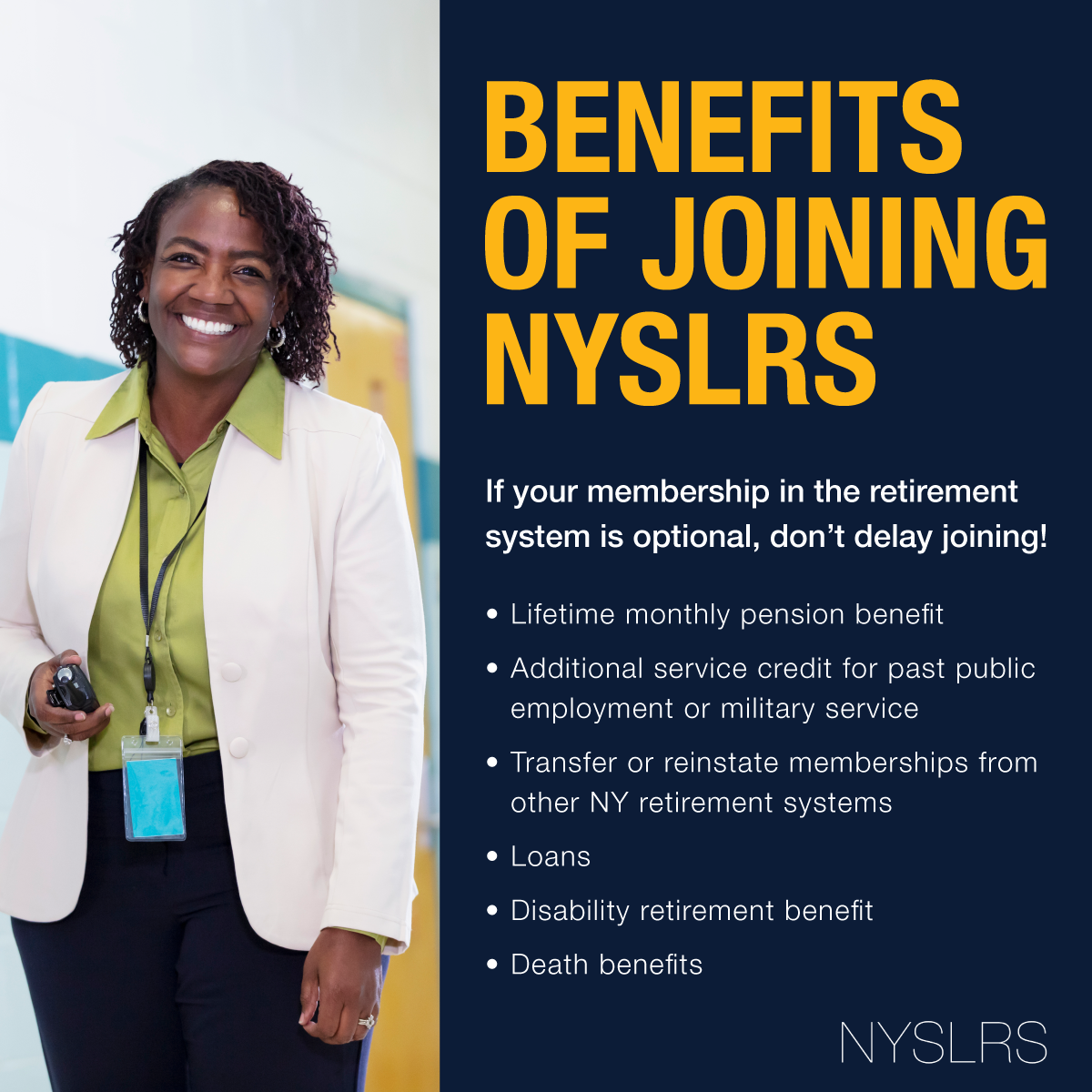
Benefits of Joining NYSLRS

NYSLRS is one of the largest retirement systems in the world, administering benefits for more than 1.2 million members, retirees and beneficiaries.

If you aren’t sure whether to join NYSLRS, here are the advantages:

  • Your NYSLRS pension is a defined benefit plan. When you retire, you will receive a monthly pension payment for the rest of your life. Once you reach retirement age, you can retire with as few as five years of service credit (part-time service is pro-rated).
  • You can request additional service credit for your public employment before joining NYSLRS or if you served in the U.S. Armed Forces and received an honorable discharge from active military duty.
  • You can transfer service if you are still a member of another public retirement system in New York State.
  • You can reinstate service if you withdrew your membership in NYSLRS or another public retirement system in New York State.
  • You can take a loan against your retirement contributions once you meet eligibility requirements.
  • NYSLRS retirement plans provide death and disability retirement benefits.

Nearly 3,000 employers participate in NYSLRS, allowing you to continue your membership if you take a job at another New York State public employer. And if you decide to leave public employment before you have ten years of service credit, you can withdraw your contributions plus interest or roll over your contributions into another retirement savings plan.

NYSLRS Membership Basics

Once you join and become a NYSLRS member:

Don’t Delay Joining

It’s important to join NYSLRS at the start of your employment. If you don’t join right away, you can purchase service credit for your public employment from before you became a member, but it will cost more—6% of your earnings plus interest rather than contributing a percentage based on your earnings. Also, while you can request previous service credit and pay for the cost at any time, you must earn two years of service credit as a NYSLRS member before your purchased service can be credited.

Get Credit for All Your Public Service

Because service credit is a major factor in calculating your pension benefit, it’s important to make sure you get credit for all your public service. Once you join NYSLRS, you should request any additional service as early in your career as possible.

  • NYSLRS will need time to request records from your previous employer or retirement system.
  • The sooner you purchase your credit, the less it will generally cost.
  • Requesting early gives you time to pay for additional service.

Your request will be reviewed to determine your eligibility. We will send you a letter with the amount of service credit you are eligible to receive if you choose to purchase it, the cost and payment options. There are certain situations where purchasing additional service credit will not increase your pension. For more information, read about whether should you purchase additional service credit.

NYSLRS – One Tier at a Time: ERS Tier 6

When you join the New York State and Local Retirement System (NYSLRS), you’re assigned a tier based on the date of your membership. This post looks at Tier 6 members of the Employees’ Retirement System (ERS).

Your tier determines such things as your eligibility for benefits, the calculation of those benefits, death benefit coverage and whether you need to contribute toward your benefits.

ERS has six tiers. Anyone who joined ERS on or after April 1, 2012 is in Tier 6. There were 350,986 ERS Tier 6 members as of March 31, 2022. At 54 percent of membership, Tier 6 is the largest ERS tier.

Most ERS Tier 6 members (unless they are in special retirement plans) retire under the Article 15 retirement plan. Check out the graphic below for the basic retirement information for Tier 6 members in this plan.

ERS Tier 6

Membership Milestones

As of April 9, 2022, Tier 6 members only need five years of service credit to become vested. If you are a vested member in the Article 15 retirement plan, you are eligible for a lifetime pension benefit as early as age 55, but if you retire before the full retirement age of 63, your benefit will be reduced.

If you retire with fewer than 20 years, the benefit is 1.66 percent of your final average earnings (FAE) for each year of service. If you retire with exactly 20 years of service, the benefit is 1.75 percent of your FAE for each year of service (35 percent of your FAE).

If you retire with more than 20 years of service, you’ll receive 35 percent for the first 20 years, plus 2 percent for each additional year. For example, with 35 years of service you can retire at age 63 with 65 percent of your FAE.

Where to Find More ERS Tier 6 Information

For more information about ERS Tier 6 membership, find your NYSLRS retirement plan publication. It’s a comprehensive description of the benefits provided by your specific plan.

You can check your service credit total and estimate your pension using Retirement Online. Most members can use our online pension calculator to create an estimate based on the salary and service information NYSLRS has on file for them. You can enter different retirement dates to see how your choices would affect your potential benefit.

Members may not be able to use the Retirement Online calculator in certain circumstances, for example, if they have recently transferred a membership to NYSLRS, or if they are a Tier 6 member with between five and ten years of service. These members can contact us to request an estimate or use the “Quick Calculator” on our website. The Quick Calculator generates estimates based on information you provide.  

NYSLRS – One Tier at a Time: PFRS Tier 6

When you join the New York State and Local Retirement System (NYSLRS), you’re assigned a tier based on the date of your membership. This post looks at Tier 6 members of the Police and Fire Retirement System (PFRS).

Your tier determines such things as your eligibility for benefits, the calculation of those benefits, death benefit coverage and whether you need to contribute toward your benefits.

PFRS has five tiers. Anyone who joined PFRS on or after April 1, 2012 is in Tier 6. There are 16,027 Tier 6 members, which accounts for more than 45 percent of PFRS membership, making it the second largest PFRS tier.

About Regular Plans and Special Plans

Under a regular retirement plan, you need to reach certain age and service requirements to receive your NYSLRS pension. If you’re covered by a special retirement plan, there is no age requirement, and you can receive your pension after completing 20 or 25 years of service.

Eighty percent of PFRS members are in plans covered under Sections 384, 384-d, 384-e or 384-f of the New York State Retirement and Social Security Law. Read our Police and Fire Retirement System blog post for information about different PFRS plans.

Check out the graphic below for the basic retirement information for PFRS Tier 6 members.

PFRS Tier 6

Where to Find PFRS Tier 6 Information

For more information about PFRS Tier 6 membership, find your NYSLRS retirement plan publication. It’s a comprehensive description of the benefits provided by your specific plan.

You can check your service credit total and estimate your pension using Retirement Online. Most members can use our online pension calculator to create an estimate based on the salary and service information NYSLRS has on file for them. You can enter different retirement dates to see how your choices would affect your potential benefit.

As of April 9, 2022, Tier 5 and 6 members only need five years of service credit to be vested. Tier 5 members with five or more years of service can estimate their pension benefit in Retirement Online. If you are a Tier 6 member with between five and ten years of service credit, you can contact us to request a benefit estimate.

ERS Tier 6 Benefits – A Closer Look

Financial advisers say you will need to replace between 70 and 80 percent of your salary to maintain your lifestyle after retirement. Your NYSLRS pension could go a long way in helping you reach that goal, especially when combined with your Social Security benefit and your own retirement savings. Here’s a look at how Employees’ Retirement System (ERS) members in Tier 6 (who are vested once they’ve earned five years of credited service), can reach that goal. Members who joined NYSLRS since April 1, 2012 are in Tier 6.

formula for a financially secure retirement

Calculating an ERS Tier 6 Member’s Pension

Your NYSLRS pension will be based on your Final Average Earnings (FAE) and the number of years you work in public service. FAE is the average of the five highest-paid consecutive years. Note: The law limits the FAE of all members who joined on or after June 17, 1971. For example, for most members, if your earnings increase significantly through the years used in your FAE, some of those earnings may not be used toward your pension.  

Although ERS members can generally retire as early as age 55 with reduced benefits, the full retirement age for Tier 6 members is age 63.

For ERS Tier 6 members in regular plans (Article 15), the benefit is 1.66 percent of your FAE for each full year you work, up to 20 years. At 20 years, the benefit equals 1.75 percent per year for a total of 35 percent. After 20 years, the benefit grows to 2 percent per year for each additional year of service. (Benefit calculations for members of the Police and Fire Retirement System and ERS members in special plans vary based on plan.)

Say you begin your career at age 28 and work full-time until your full retirement age of 63. That’s 35 years of service credit. You’d get 35 percent of your FAE for the first 20 years, plus 30 percent for the last 15 years, for a total benefit that would replace 65 percent of your salary. If you didn’t start until age 38, you’d get 45 percent of your FAE at 63.

Examples of ERS Tier 6 Pension Calculation

So, that’s how your NYSLRS pension can help you get started with your post-retirement income. Now, let’s look at what the addition of Social Security and your own savings can do to help you reach your retirement goal.

Other Sources of Post-Retirement Income

Social Security: According to the Social Security Administration, Social Security currently replaces about 40 percent of the wages of a typical worker who retires at full retirement age. In the future, these percentages may change, but you should still factor it in to your post-retirement income.

Your Savings: Retirement savings can also replace a portion of your income. How much, of course, depends on how much you save. The key is to start saving early so your money has time to grow. New York State employees and some municipal employees can participate in the New York State Deferred Compensation Plan. If you haven’t already looked into Deferred Compensation, you might consider doing so now.